Leftover rice is one of the most useful foods to have in the fridge. It can become a quick side dish, the base of a curry night, or a fast lunch with a fried egg on top. But maybe your microwave has stopped working, maybe you are staying somewhere that doesn’t have one, or maybe you simply don’t like what it does to rice. Microwaved rice often ends up hot at the edges and cold in the middle, with a few hard, dry grains on top.
The good news is that you don’t need a microwave at all. A pan, a steamer, the oven, an air fryer or a rice cooker can all bring cold rice back to soft, fluffy and steaming hot. Many people find the results better than the microwave. And if you are managing without a microwave in general, our guide on how to use an oven as a microwave shows how to handle other leftovers too.
In this guide, you will learn:
- how to keep leftover rice safe (this matters more than the method you pick)
- six ways to reheat rice without a microwave, with simple steps
- how to handle different types of rice
- the common mistakes that make rice dry, mushy or unsafe
Read This Before You Reheat
Reheating rice is safe. What matters is how the rice was stored before you reheated it. Rice is a little different from most leftovers, so it is worth taking a minute to understand why.
Uncooked rice can carry tiny spores of a bacterium called Bacillus cereus. These spores survive normal cooking. If cooked rice then sits at room temperature, the spores can wake up and grow into bacteria, and those bacteria can release toxins. The toxins are the real problem, because reheating does not destroy them. As the Delicious magazine guide to storing cooked rice points out, rice that has been left out for too long cannot be rescued by heating it up again. The UK’s NHS says that eating rice affected this way can cause vomiting or diarrhea about one to five hours later. The symptoms are usually mild and pass in about a day, but nobody wants them.
The rules to follow are simple:
- Cool the rice quickly. Try to get it into the fridge within about one hour of cooking. The NHS gives one hour as the ideal. The USDA’s general rule for all leftovers is within two hours, but with rice, sooner is better. Spreading the rice in a thin layer on a tray helps it cool fast.
- Store it in an airtight container in the fridge.
- Eat it soon. The NHS advises keeping rice in the fridge for no more than one day before reheating. The USDA’s leftover guidance allows three to four days for leftovers in general. Because rice has this special risk, the shorter time is the safer choice.
- Reheat it only once. Take out only the amount you plan to eat, and leave the rest in the fridge.
- Make it steaming hot all the way through. The USDA says leftovers should reach 165°F (74°C), measured with a food thermometer.
- Don’t leave it sitting warm for hours. Leftover rice should not be left in a turned-off oven or rice cooker overnight. NC State Extension shares this tip too.
If rice smells strange or feels slimy, throw it away. But keep in mind that rice can look and smell normal even when it has been stored badly, so the storage rules matter more than the sniff test.
Get the Rice Ready First
Three small steps help with every method below.
- Break up the clumps. Cold rice sticks together in the fridge. Use a fork or slightly wet hands to loosen it. Big clumps heat unevenly and leave cold spots in the middle.
- Add a little water. About 1 tablespoon per cup of rice is a good starting point. The water turns into steam and softens the grains again.
- Cover it. A lid, a plate or a piece of foil traps the steam. Rice reheated without a cover dries out fast.
You can reheat rice straight from the fridge. There is no need to let it sit on the counter first, because that only gives bacteria more time to grow.
Method 1: Reheat Rice on the Stovetop
Best for: small to medium portions when you want it quick and want full control.
The stovetop is the classic way to reheat rice without a microwave, and it works well because you can see and stir the rice as it heats.
- Put the rice in a non-stick pan or small saucepan and break up any clumps.
- Sprinkle in about 1 tablespoon of water per cup of rice. Add a small knob of butter or a few drops of oil if you like.
- Cover with a lid and heat on low to medium heat.
- After a minute or two, stir the rice and cover it again.
- Keep heating for about 3 to 5 minutes in total, until steam rises from the center and the rice is hot all the way through.
If the rice looks dry, add another small splash of water. Don’t turn the heat up to high. The rice at the bottom will stick and scorch before the top is hot. If you own an Instant Pot or electric pressure cooker, its Sauté mode on the lowest setting works just like a pan.
Method 2: Steam the Rice
Best for: the softest, most “just cooked” texture, especially for sticky or short-grain rice.
Steaming is gentle. Instead of drying the rice out, it puts moisture back into every grain, so this method gets closest to freshly cooked rice.
- Fill a pot with a couple of inches of water and bring it to a boil. Using hot water from a kettle saves time.
- Put the rice in a heatproof bowl or plate that fits inside your steamer basket. If you use a bamboo steamer, line it with parchment paper (with a few holes poked in it) or a clean damp cloth so no grains fall through.
- Sprinkle a little water over the rice and cover it.
- Steam for about 3 to 6 minutes, until the rice is steaming hot in the center.
- Fluff it with a fork and serve.
No steamer? Place a small heatproof plate on top of a trivet, a small rack or a few balls of foil inside a wide pot with a little water in the bottom. Put the rice on the plate, cover the pot with a lid and steam as above.
Method 3: Reheat Rice in the Oven
Best for: large batches, or when the oven is already on for another dish.
The oven is slower than the other methods, but it heats a big portion evenly and needs very little attention.
- Preheat the oven to 350°F (175°C).
- Spread the rice in an oven-safe dish in an even layer. Try not to pile it more than about two inches deep.
- Add a splash of water (roughly 1 tablespoon per cup) and dot the top with a little butter or oil.
- Cover the dish tightly with foil or a lid. This step is important, because uncovered rice turns dry and hard.
- Bake for 15 to 20 minutes. If you can, stir once halfway through.
- Check that the rice is steaming hot in the middle, then fluff and serve.
Some cooks use a slightly lower oven. The Delicious magazine guide above suggests about 300°F (150°C) for 15 to 20 minutes, covered with foil, which also works if you are not in a hurry. If you would rather skip the long preheat, the air fryer below is faster, and our oven to air fryer conversion chart helps you move any oven setting over to it.
Method 4: Reheat Rice in the Air Fryer
Best for: small portions, and for people who like a little crispness on top.
An air fryer is basically a small, fast oven with a fan, so it heats rice quickly. The one rule is to keep the rice in a bowl or dish. Loose rice placed straight in the basket can dry out or get blown around.
- Preheat the air fryer to 350°F (180°C) if your model asks for it.
- Put the rice in a small, air-fryer-safe bowl or dish. Break up the clumps and sprinkle with a little water.
- Cover loosely with foil and tuck the edges down so the fan can’t lift it.
- Cook for about 4 to 6 minutes, stirring once halfway through.
- For a lightly toasted top, remove the foil for the last minute or two.
If you are used to microwave timings and want the matching air fryer setting, try our microwave to air fryer converter. You can also read our article on whether an air fryer can replace a microwave to see where it works well and where it doesn’t.
Method 5: Reheat Rice in a Rice Cooker
Best for: hands-off reheating, if you already own a rice cooker.
- Put the rice in the inner pot and break up the clumps.
- Add about 2 tablespoons of water per cup of rice. The cooker switches off when the water is gone, so a little extra helps here.
- Close the lid and press the regular Cook button (or the Reheat button, if your cooker has one).
- When the cooker clicks over to Keep Warm, open the lid and stir the rice. Check that it is steaming hot all the way through. If there are cold spots, add another splash of water and press Cook again.
- Serve right away.
The Keep Warm setting is made for holding rice that is already hot. It is not meant for heating cold rice, so don’t rely on it alone. And as mentioned in the safety section, don’t leave the rice sitting in the cooker for hours afterward.
Method 6: Reheat Rice in a Frying Pan or Wok
Best for: fried rice, or when you want golden, toasty bits.
Cold, slightly dry rice is actually the best base for fried rice, so a hot pan is a smart choice when you have leftovers.
- Heat a little oil in a frying pan or wok over medium-high heat.
- Add the cold rice and break up the clumps with a spatula.
- Stir-fry for about 3 to 5 minutes, until the rice is steaming hot and the grains are separate.
- Add vegetables, egg, soy sauce or whatever you like, and keep stirring for another minute.
If the rice is already fried rice, don’t add water. Just heat it in a pan with a little oil. Chef Savvy tested four ways to reheat fried rice and, in her fried rice reheating test, put the stovetop first and the air fryer second. The oven came last because it dried the rice out.
Which Method Should You Choose?
There is no single best method. It depends on how much rice you have and what you want from it.
- For speed, use the stovetop or the air fryer.
- For the softest rice, use a steamer.
- For a big batch, use the oven.
- For the least effort, use a rice cooker.
- For crispy, golden rice, use a frying pan or wok.
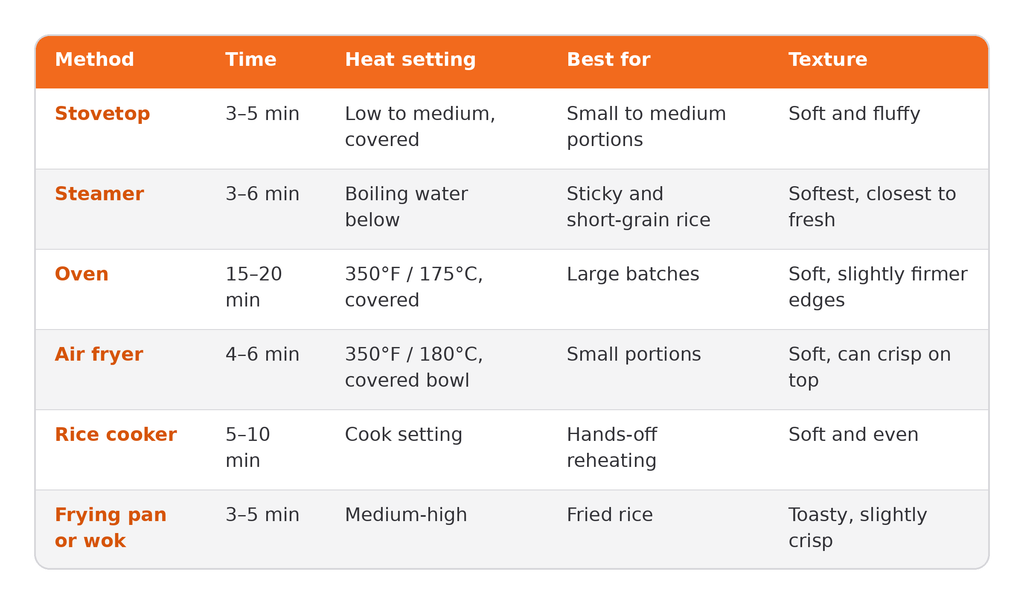
The table below puts all six methods side by side.
Reheating Different Types of Rice
Not all rice behaves the same way. Long-grain rice stays fluffy, brown rice stays chewy, and sticky rice dries out quickly. A few small changes make a big difference.
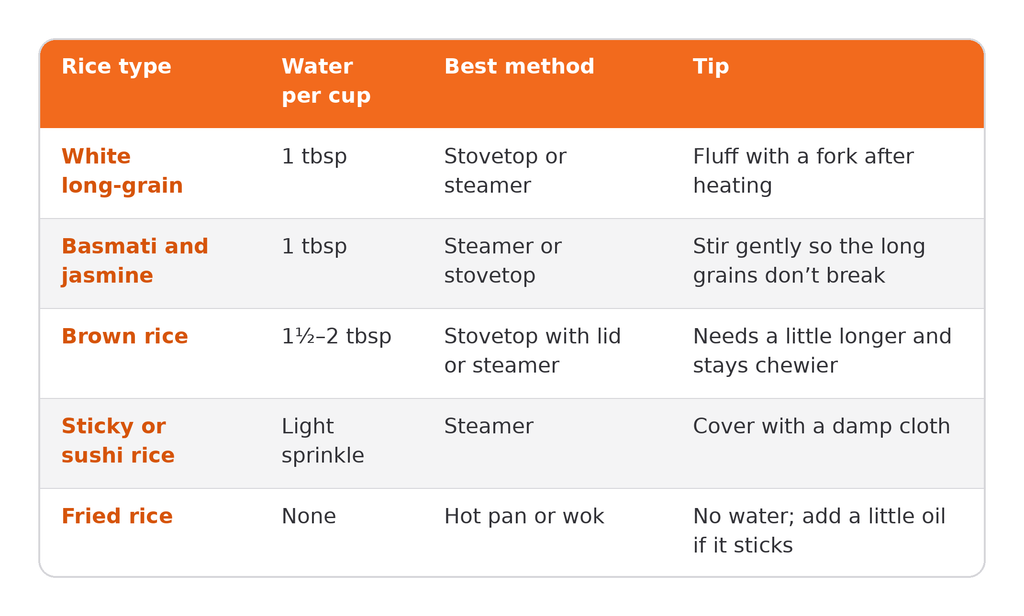
In short, give brown rice a little more water and a little more time, handle basmati gently so the long grains don’t snap, and keep sticky rice covered with a damp cloth so the outside doesn’t harden.
How to Know the Rice is Hot Enough
Rice is not like a steak, where you can judge doneness by touch. Here are the ways to check:
- Look for steam. You should see steam rising from the center of the rice, not just from the edges.
- Use a thermometer. This is the most reliable check. Push it into the middle of the rice, where it is coolest. The USDA’s target for leftovers is 165°F (74°C).
- Stir and test. Mix the rice, then taste a spoonful from the center. It should be hot, not warm.
If any part is still cool, cover it and heat it for another minute, then check again.
Common Mistakes to Avoid
- Adding too much water. This makes rice mushy. Start with a small amount and add more only if it looks dry.
- Using high heat. The bottom burns while the middle stays cold. Medium or low heat is safer.
- Skipping the cover. Without a lid or foil, the steam escapes and the grains turn hard.
- Piling the rice too deep. A thick pile heats unevenly. Spread it out in a shallow layer.
- Reheating the whole pot every time. Heat only what you will eat. Reheating the same rice again and again is not safe.
- Letting rice sit out first. Don’t leave it on the counter to “come to room temperature.” Go straight from the fridge to the heat.
Frequently Asked Questions
Is it safe to reheat rice? Yes, as long as the rice was cooled quickly, kept in the fridge and reheated only once until it is steaming hot all the way through. The risk comes from poor storage, not from reheating itself.
Can I reheat rice more than once? It is best not to. The NHS advises against reheating rice more than once, so take out only the portion you plan to eat.
How much water should I add when reheating rice? About 1 tablespoon per cup of rice is a good starting point for most methods. Brown rice and rice cooker reheating can take a little more. Fried rice needs none.
How long can I keep cooked rice in the fridge? The NHS says no more than one day before reheating. The USDA allows three to four days for leftovers in general. For rice, the shorter time is the safer one.
Can I reheat rice in the oven or air fryer without drying it out? Yes. Add a splash of water, put the rice in a covered dish or bowl, and use moderate heat. Covering it is the most important part.
Final Thoughts
Reheating rice without a microwave is easy once you know the basics. Break up the clumps, add a little water, cover it, and heat it gently until it is steaming hot all the way through. The stovetop and the steamer give the best texture, the oven is great for big batches, the air fryer is quick for small portions, and the rice cooker is the lazy but reliable option. Most importantly, cool your rice fast, keep it in the fridge, and reheat it only once.
Want more help with leftovers? Browse all of our reheating food guides. If you are heating something to go with your rice, our tips on reheating fried chicken in an air fryer or oven and reheating pizza in an air fryer use the same idea of matching the method to the food, so it comes out tasting like it did the first time.
