Your microwave has broken, you are staying somewhere without one, or you simply prefer not to use one. The good news is that a regular oven can do most of what a microwave does. You can reheat leftovers, cook frozen meals and bake a potato, and the results are often better because the oven crisps and browns food instead of steaming it.
The catch is that an oven works very differently from a microwave. It is slower, it needs a different kind of dish, and a few microwave jobs (defrosting, popcorn, heating a cup of water) should not be done in an oven at all. This guide explains exactly how to use an oven as a microwave, with conversion charts for cooking times, a reheating chart for 12 popular foods, a guide to oven-safe containers and the USDA safety rules you should follow.
Can You Really Use an Oven as a Microwave?
Yes, for most reheating and cooking jobs. An electric, gas or fan oven can all stand in for a microwave. What an oven cannot do is heat food the way a microwave does, so everything takes longer. Follow these four rules:
- Set the oven to 350°F (175°C). When reheating meat or poultry, the USDA says the oven should be no lower than 325°F (163°C).
- Use an oven-safe dish, cover the food with foil or a lid, and add a splash of water to anything that could dry out.
- Allow time. Reheating a plate of leftovers takes about 15–25 minutes. When cooking raw or frozen food, expect roughly 3 to 4 times the microwave time.
- Check the temperature. Leftovers are safe once they reach 165°F (74°C) on a food thermometer.
If you want to go the other way and turn an oven recipe into microwave instructions, use our oven to microwave conversion.
Can Electric, Gas and Convection Ovens Be Used as a Microwave?
Any conventional oven can replace a microwave for everyday cooking and reheating. There are only small differences between types:
- Electric and gas ovens both work the same way for this purpose. Gas ovens can have hot spots, so an oven thermometer and an occasional turn of the dish help.
- Fan or convection ovens circulate hot air and cook a little faster. Lower the temperature by about 25°F (15°C), or shorten the time by about 20%, and check early.
- Toaster ovens are the closest thing to a microwave replacement because they preheat in a few minutes and suit small portions. The heating elements sit close to the food, so cover it and check often.
- Combination microwave ovens already have a microwave mode. If your appliance has a microwave symbol and a turntable, use that setting for microwave-style heating, and use the oven or grill modes separately. Never put foil or metal dishes in the oven while it is in microwave mode.
Can you turn an oven into a microwave? No. A microwave oven needs a magnetron to generate microwaves and a shielded cavity to keep them contained. A conventional oven has neither, and there is no safe way to add them, so ignore any online conversion kits or DIY methods. The only safe option is to use the oven as an oven, with the adjustments in this guide.
How an Oven and a Microwave Heat Food Differently
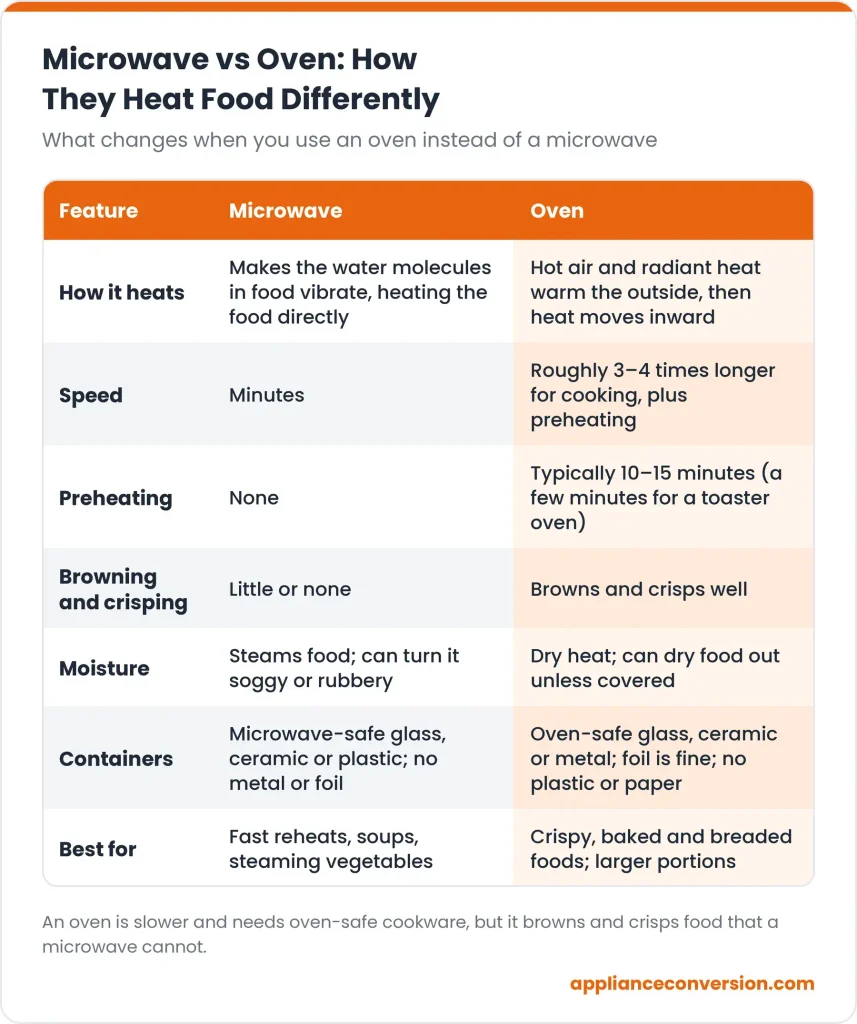
Understanding the difference explains why the conversions below work the way they do. A microwave makes the water molecules in food vibrate, which heats the food directly and quickly. An oven heats the air and the oven walls, and that heat then travels into the food slowly from the outside in.
That is why an oven takes longer, needs preheating, browns and crisps food, and can dry food out if it is left uncovered.
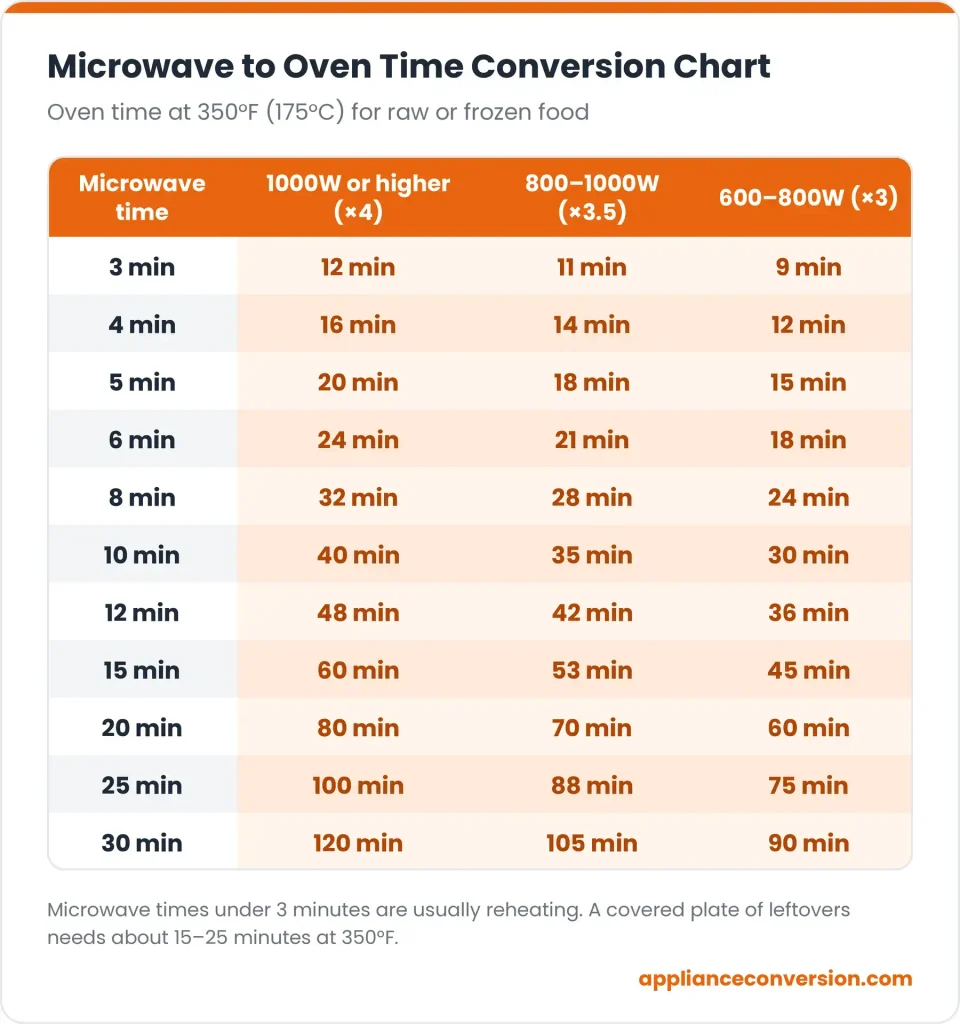
Microwave to Oven Time Conversion Chart
The standard rule is that food cooked in a microwave takes about one-quarter of the time it takes in a conventional oven. Turning that around, the oven time is roughly 3 to 4 times the microwave time, and the exact multiplier depends on the power of the microwave the instructions were written for:
- 1000 watts or higher: multiply the microwave time by 4
- 800–1000 watts: multiply by 3.5
- 600–800 watts: multiply by 3
The chart below applies these multipliers at 350°F (175°C). Use the column that matches the wattage printed on the microwave instructions. If the instructions give no wattage, use the 1000W column.
Worked examples
- A recipe that says 8 minutes in a 1000W microwave becomes about 32 minutes in a 350°F oven (8 × 4).
- A package that says 5 minutes at 800W becomes about 18 minutes in the oven (5 × 3.5).
- A dish that takes 15 minutes in a 700W microwave becomes about 45 minutes in the oven (15 × 3).
Important: this chart is for cooking raw or frozen food. Short microwave times, anything under about 3 minutes, are almost always reheating. A single plate of leftovers that takes 2 minutes in the microwave needs roughly 15–25 minutes in a covered dish in a 350°F oven, not 8 minutes. Use the reheating chart below for those jobs.
If you are searching for how long one microwave minute is in the oven, the honest answer is that there is no direct equivalent for very short times. Thickness, starting temperature and the dish all matter more than the microwave time.
How to Reheat Food in the Oven Like a Microwave, Step by Step
- Preheat the oven to 350°F (175°C). Use 325°F (163°C) at the very lowest for meat and poultry. A toaster oven preheats much faster for small portions.
- Move the food to an oven-safe dish. Never put a microwave-only plastic container or paper plate in the oven.
- Spread the food in an even layer and cut large pieces into smaller ones so the heat reaches the center. The USDA advises spreading food evenly to avoid cold spots.
- Add moisture. A tablespoon or two of water, broth or sauce keeps rice, pasta, casseroles and meat from drying out.
- Cover the dish with foil or a lid. Covering holds in steam, which is what keeps oven-reheated food moist.
- Heat for the time in the chart below, stirring or turning the food halfway if you can.
- Uncover for the last 3–5 minutes if you want crispy edges, then check the temperature in several spots. Food should reach 165°F (74°C).
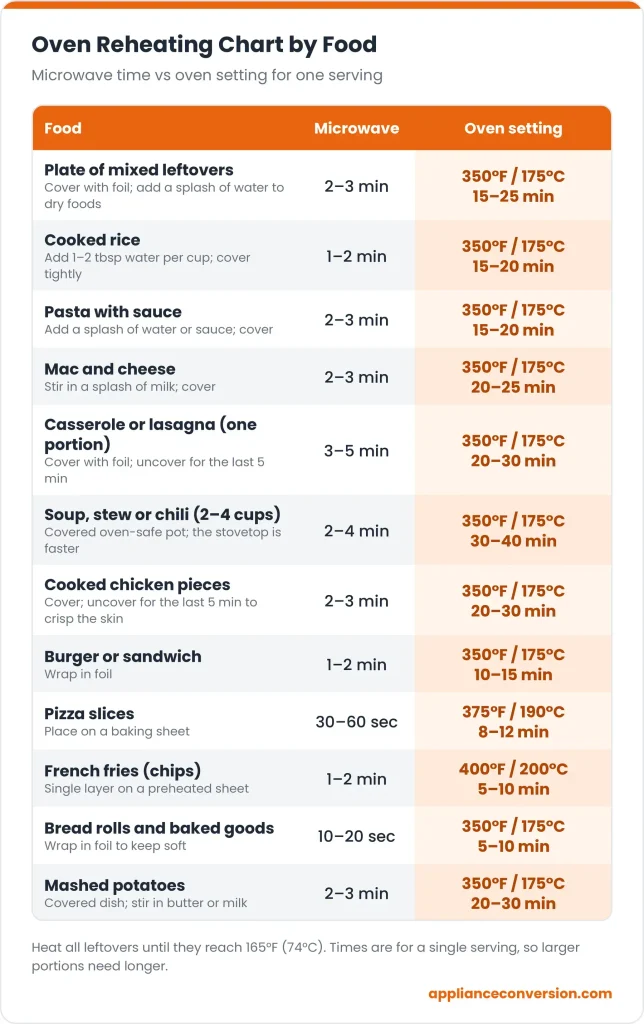
Oven Reheating Chart by Food
This chart shows the typical microwave time for each food alongside the oven setting that does the same job. Times are for a single serving; larger or deeper portions need longer, so always check the center.
For more detail on two popular foods, see our guides to reheating chips in the microwave or oven and the best way to reheat steak without overcooking it.
How to Cook Common Microwave Foods in the Oven
Microwaves are also used to cook food from raw or frozen, such as potatoes, bacon and frozen meals. Here is how the same jobs work in an oven.
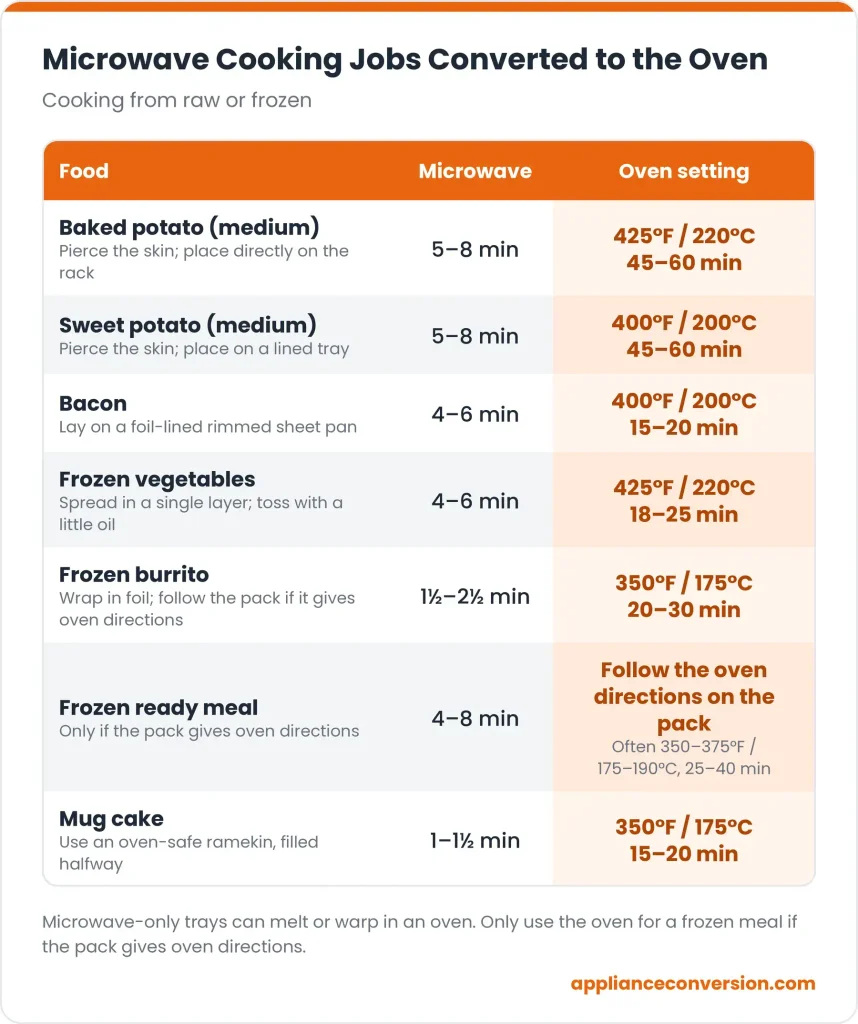
A few notes on these foods:
- Frozen meals and burritos: most packages list oven directions as well as microwave directions. Use those instead of converting, because the tray and food are designed for it. Only use the oven if the pack gives oven instructions. Microwave-only trays can melt or warp.
- Baked potatoes: the oven takes far longer than the microwave, but the skin turns crisp. Pierce the potato a few times first.
- Mug cakes: use an oven-safe ramekin or mug rather than a regular microwave mug, and fill it no more than halfway.
Oven-Safe Containers: What You Can and Cannot Use
The biggest difference when switching from microwave to oven is the cookware. Foil and metal are fine in an oven but dangerous in a microwave, and many microwave-safe plastics melt in an oven. A dish labeled microwave-safe is not automatically oven-safe.
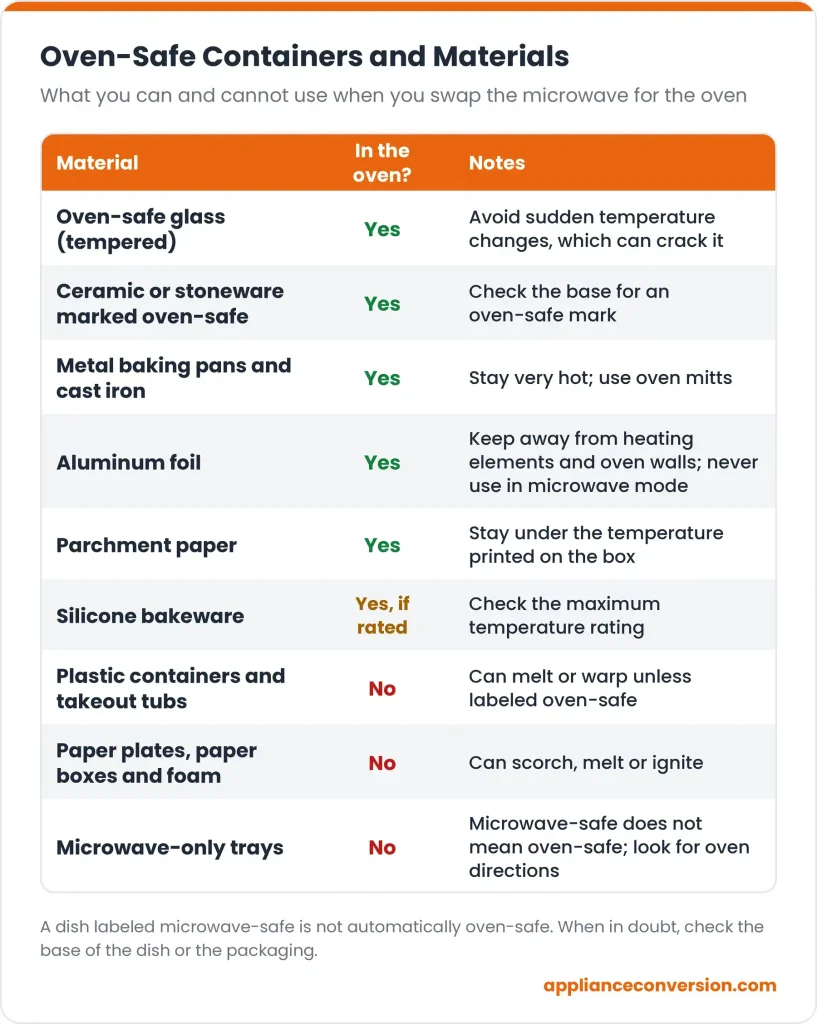
Glass deserves one extra warning. Even oven-safe glass can crack if it goes from the refrigerator straight into a hot oven or from the oven onto a wet or cold surface. Let a cold dish sit out for a few minutes where it is safe to do so, and place hot dishes on a dry towel or trivet.
Tips to Stop Food Drying Out in the Oven
The biggest complaint about reheating in an oven is dry food. These habits make a big difference:
- Always cover the dish with foil or a tight lid for most of the heating time.
- Add a splash of liquid such as water, broth, milk or sauce.
- Put a small oven-safe dish of water on the lower rack to add steam when reheating bread or baked goods.
- Use a shallow dish so the food heats evenly and quickly instead of drying out on the outside while the middle stays cold.
- Keep portions small. Reheating one serving at a time gives better results than a large block of food.
- Do not use a lower temperature to be gentle with meat. The USDA says to keep the oven at 325°F or above when reheating meat and poultry.
USDA Guidelines For Reheating Safely
Oven reheating takes longer than microwaving, so it is worth knowing the safety rules. The USDA Food Safety and Inspection Service summarizes them in its guide to leftovers and food safety.
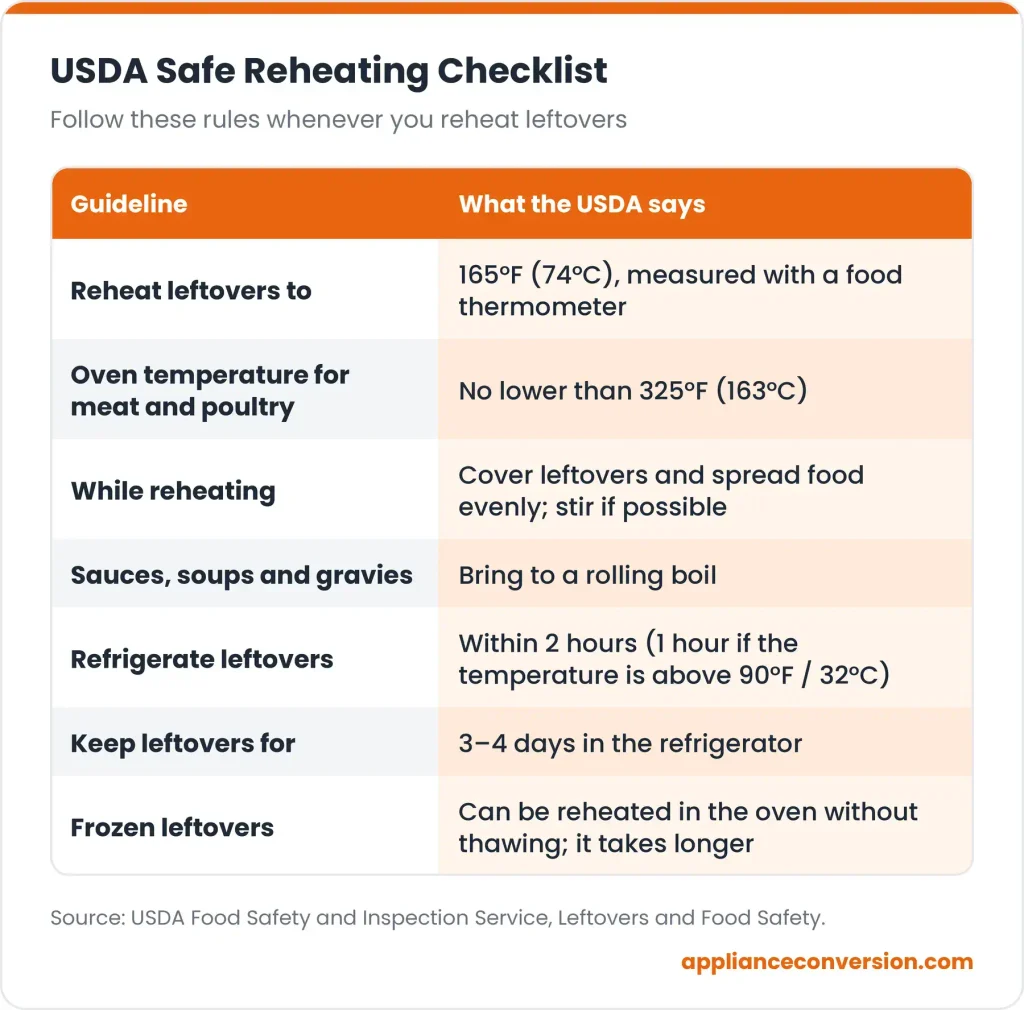
The key points are simple: measure the temperature rather than guessing, cover the food, and never let leftovers sit out for long before they go into the refrigerator.
Microwave Jobs That Do Not Work in an Oven
Some microwave tasks have no good oven equivalent, and one of them is a genuine food safety risk.
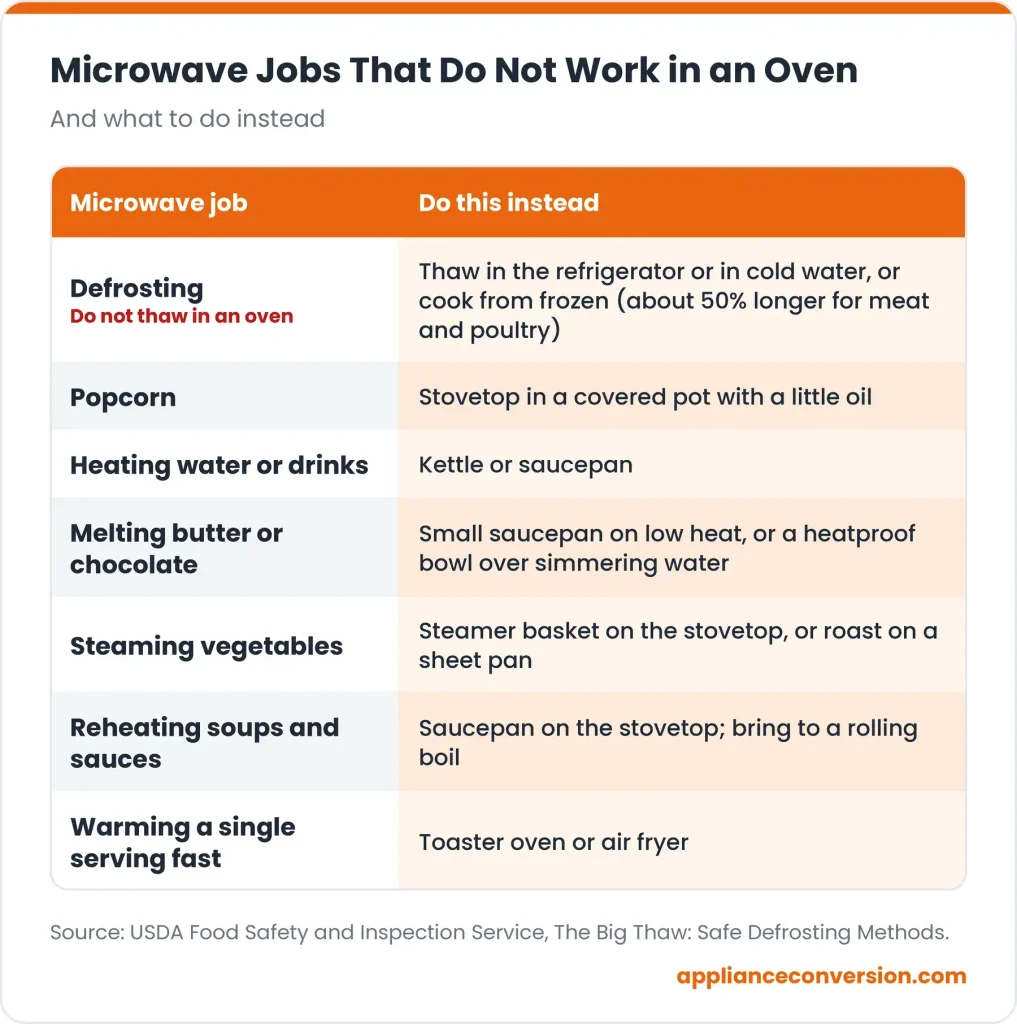
Defrosting is the one to avoid. Warming frozen food slowly in an oven, even on a low setting, lets the outer layer sit in the temperature danger zone (40–140°F) while the center is still frozen. The USDA lists only three safe ways to thaw food: in the refrigerator, in cold water and in the microwave. If you have no microwave and no time, the USDA says it is safe to cook food straight from frozen. Cooking takes about 50% longer than for thawed or fresh meat and poultry. See the USDA guide to safe defrosting methods.
Faster Alternatives if You Do Not Have a Microwave
If the oven feels like too much effort for a quick meal, these appliances are closer to a microwave in speed:
- Toaster oven: preheats in minutes and is ideal for single portions of pizza, sandwiches and baked goods.
- Air fryer: reheats crispy foods quickly and makes them better than a microwave can. See our microwave to air fryer conversion guide and our oven to air fryer conversion chart. For pizza, try reheating pizza in an air fryer.
- Stovetop: the best choice for soups, stews, sauces, rice and pasta. It heats liquids faster than an oven and makes it easy to bring them to a rolling boil, which the USDA recommends for soups, sauces and gravies.
Common Mistakes When Using an Oven Instead of a Microwave
- Using the microwave time as the oven time. One minute in a microwave is not one minute in an oven.
- Using microwave-only dishes or trays. Plastic, paper and foam can melt, scorch or ignite.
- Skipping the cover. Uncovered food dries out quickly.
- Reheating at too low a temperature. Low-and-slow keeps food in the danger zone for longer and is not recommended for meat and poultry.
- Not checking the center. Oven-reheated food can be hot on the outside and cold in the middle.
- Defrosting in the oven. Use the refrigerator or cold water, or cook from frozen.
Frequently Asked Questions
Can I use my oven instead of a microwave?
Yes. A conventional oven can reheat leftovers and cook most foods that a microwave cooks. It is slower and needs oven-safe cookware, but it browns and crisps food that a microwave cannot.
How long does it take to reheat food in the oven compared with the microwave?
A single plate of leftovers that takes 2–3 minutes in a microwave takes about 15–25 minutes in a covered dish in a 350°F (175°C) oven. For cooking raw or frozen food, the oven needs roughly 3 to 4 times the microwave time.
What temperature should I use to reheat food in the oven?
350°F (175°C) works for most foods. The USDA says the oven should be no lower than 325°F (163°C) for meat and poultry, and all leftovers should reach 165°F (74°C) inside.
Can I put a microwave meal in the oven?
Only if the package gives oven directions. Many microwave meals come in trays that melt or warp in an oven. If the pack lists both methods, follow the oven instructions.
Can I defrost food in the oven?
No. Thawing in an oven can leave the outside of the food in the temperature danger zone while the center is still frozen. Thaw in the refrigerator or in cold water, or cook the food from frozen.
Can I use foil in the oven like I cannot in the microwave?
Yes. Foil is fine in a conventional oven and is useful for covering food while it reheats. Keep it away from the heating elements and oven walls. Never use foil or metal in a microwave or in the microwave mode of a combination oven.
Can I turn my oven into a microwave?
No. Microwave ovens need a magnetron and a shielded cavity, which a conventional oven does not have. Do not try to modify an oven or use conversion kits.
Does reheating in the oven dry food out?
It can if the food is uncovered. Cover the dish, add a splash of liquid, use a shallow dish and keep portions small to keep food moist.
How do I reheat leftovers safely?
Cover the food, spread it evenly and heat it until it reaches 165°F (74°C) on a food thermometer. Refrigerate leftovers within 2 hours of cooking (1 hour if the room is above 90°F) and eat them within 3–4 days.
Final Thoughts
You can use an oven as a microwave for almost everything except defrosting and a few quick tricks like popcorn and heating water. Preheat to 350°F (175°C), use an oven-safe dish, cover the food, add a little moisture and check that it reaches 165°F (74°C). Bookmark the charts on this page for quick reference, and use the oven to microwave conversion guide when you need to switch the other way.
You may also like:
