Short answer; Yes Air Fryer can replace Microwave but partly. An air fryer can replace a microwave for reheating crispy foods, cooking frozen snacks and making small-batch meals, and it does those jobs better than a microwave ever could. It cannot replace a microwave for heating liquids, steaming food in a covered bowl, popping bagged popcorn or thawing food in a hurry. For most kitchens the smartest setup is to keep both, or to buy a combination microwave that has an air fry mode built in.
If you are short on counter space, living in a dorm or RV, or simply tired of soggy leftovers, it is a fair question. Air fryers have become one of the most popular small appliances in the kitchen, and many people now reach for them before they reach for the microwave. But the two machines heat food in completely different ways, so each is good at jobs the other struggles with.
This guide gives you a straight answer, task by task. You will find side-by-side comparisons, a microwave-to-air-fryer conversion chart for reheating, cooking times for frozen and raw foods, an energy-use comparison, a container safety chart, and a practical plan for going (almost) microwave-free.
Key Takeaways
- Yes, for crisp foods: pizza, fries, fried chicken, egg rolls, pastries and anything that should be crunchy come out better from an air fryer.
- No, for liquids and steaming: soup, coffee, milk, oatmeal and steamed vegetables need a microwave, a kettle or a stovetop.
- Speed is the big trade-off: reheating in an air fryer usually takes about 3 to 5 times longer than the microwave, plus an optional preheat.
- Energy: for small reheating jobs an air fryer uses roughly 4 to 8 times more electricity than a microwave, though the cost is still only a few cents per use.
- Safety: reheat leftovers to 165°F (74°C) in either appliance, and use only containers that are safe for the appliance you are using.
- Best of both worlds: keep a microwave for quick and wet jobs, and use the air fryer for anything where texture matters.
How an Air Fryer and a Microwave Actually Heat Food
Understanding the science makes the rest of this article easy to follow.
A microwave produces microwave radiation, at about 2.45 GHz in household models, that makes the water molecules in food vibrate and heat up. The energy reaches only about an inch (2.5 cm) into food, and the rest of the heating happens by conduction. That is why microwaves are fast, why they heat unevenly and leave cold spots, and why the results are soft and steamy. A microwave heats the water in food but does nothing to dry or brown the surface.
An air fryer is a compact, high-powered convection oven. A heating element sits above the food and a strong fan pushes hot air around it, usually in a perforated basket. The moving hot air dries the surface and triggers browning, which is where the crisp texture comes from. Most air fryers run from roughly 170°F up to 400°F (about 75°C to 200°C), and some reach 450°F (230°C). Because the heat starts at the surface and works inwards, air fryers are slower than microwaves but give much better texture.
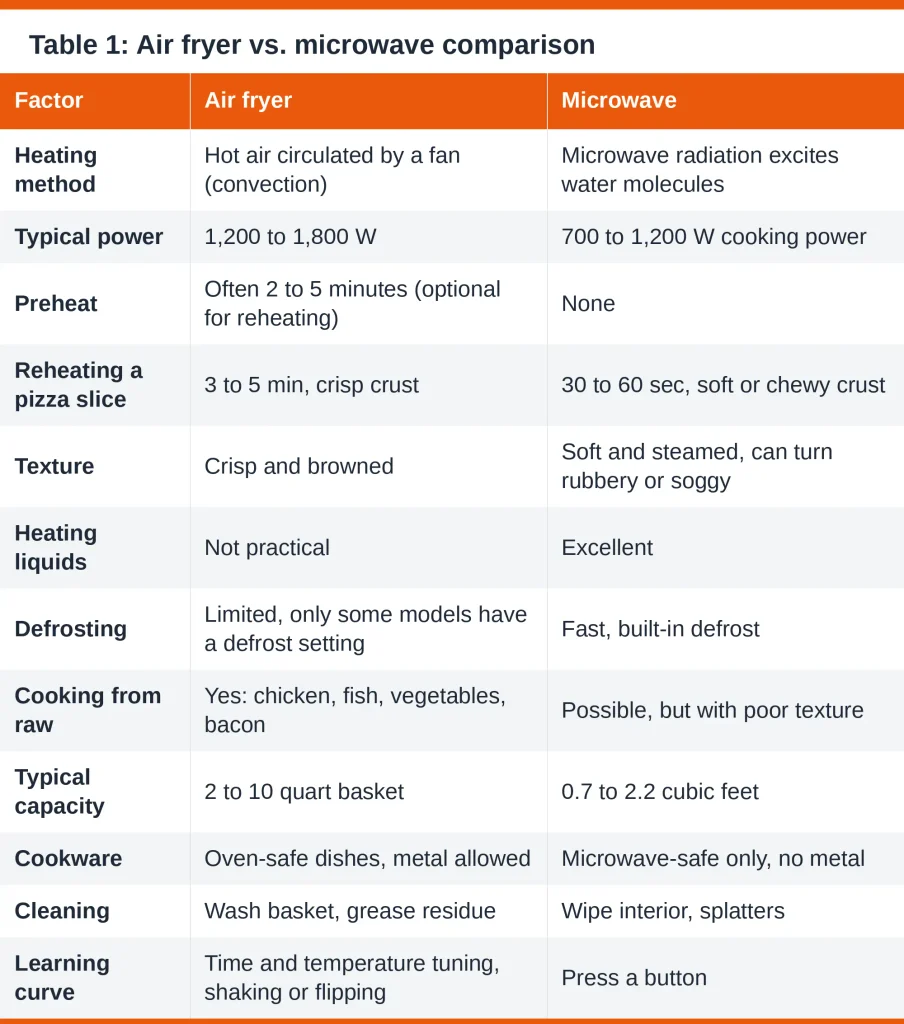
In short, the microwave wins on speed and moisture, and the air fryer wins on texture and browning.
Air Fryer vs. Microwave at a Glance
Air fryer vs. microwave comparison
What an Air Fryer Does Better Than a Microwave
Reheating anything that should be crisp. Pizza, fries, fried chicken, wings, spring rolls, croissants and roasted vegetables all come back to life in the air fryer. In the microwave they turn limp.
Cooking from frozen. Fries, nuggets, fish sticks, mozzarella sticks and dumplings are designed to be crisp. The air fryer cooks them in 5 to 18 minutes without a long oven preheat.
Cooking from raw. Bacon, salmon fillets, chicken breasts, wings and vegetables cook well in an air fryer. They are possible in a microwave, but the texture is rarely good.
Hard-boiled eggs without the risk. Whole eggs in the shell can burst in a microwave. In an air fryer, eggs cook gently at a low temperature and peel easily afterwards.
Doing the job of a small oven or toaster. Toast, roasted nuts, small baked items and crisping up bread all fit the air fryer, which saves you from heating a full-size oven.
What a Microwave Does Better Than an Air Fryer
Speed. Nothing beats a microwave for a 45-second reheat.
Liquids. Coffee, tea, milk, soup, stew and sauces need a container that holds liquid. An air fryer basket is perforated and the fan can spill or splash hot liquid, so it is not a suitable tool.
Steaming. Steam bags, covered bowls of vegetables and microwave rice cups rely on trapped moisture. An air fryer roasts rather than steams.
Porridge, oatmeal and instant meals. These rely on adding hot water or milk, which the microwave does in two minutes.
Melting and softening. Butter, chocolate and cheese melt in seconds in the microwave. The air fryer is not practical for any of these.
Defrosting. A microwave can thaw meat or leftovers in minutes. Most air fryers cannot, and the outside of food can start to cook before the middle thaws.
Bagged popcorn. Microwave popcorn bags are made for the microwave.
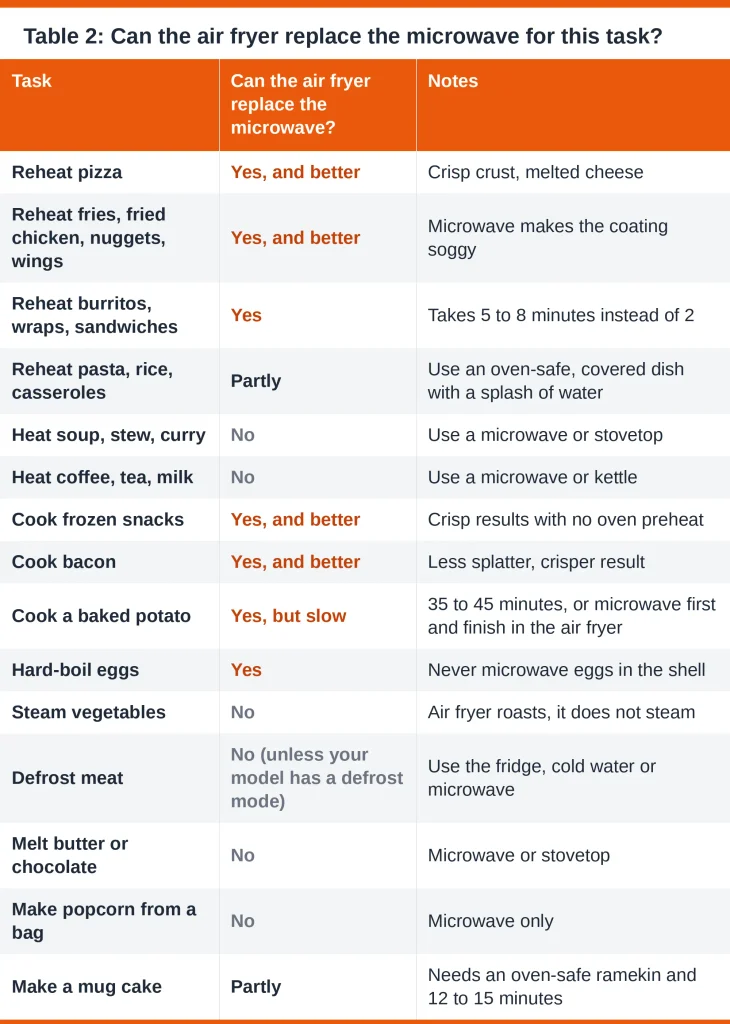
Can the Air Fryer Replace the Microwave for This Task?
Task-by-task replacement guide
Microwave to Air Fryer Conversion Chart for Reheating Leftovers
There is no exact formula for converting microwave time to air fryer time, because the two machines heat in completely different ways. As a rough guide, reheating in an air fryer takes about 3 to 5 times as long as in a microwave, and it works best at 300°F to 375°F (150°C to 190°C). Thick or dense foods need a lower temperature so the outside does not dry out before the middle is hot. The chart below shows tested starting points. Adjust for your model, the amount of food and how crisp you like it.
If you want to convert an oven recipe rather than a microwave one, use our oven to air fryer converter and oven to air fryer conversion chart.
Cooking From Raw or Frozen: Microwave vs. Air Fryer
This is where the air fryer really earns its place on the counter. Many foods that people microwave out of habit taste far better from the air fryer.
Raw and frozen foods, microwave vs. air fryer
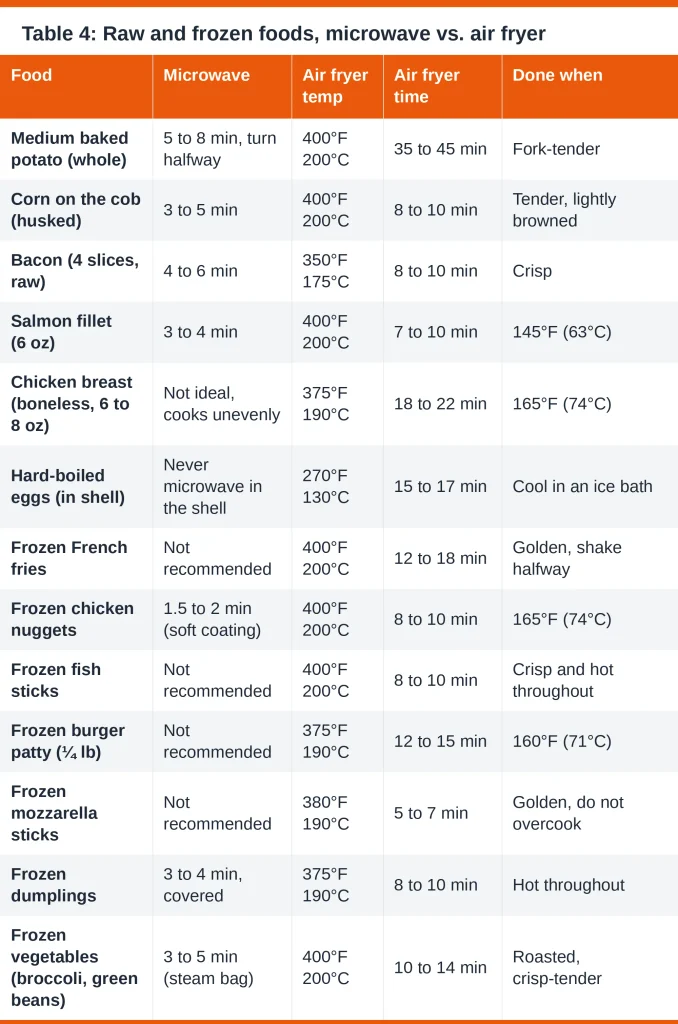
Package directions always come first. Where a product label gives air fryer instructions, follow those.
For a baked potato, a hybrid method saves time: microwave for 3 to 4 minutes to cook the middle, then finish at 400°F (200°C) in the air fryer for 10 to 15 minutes to get crisp skin.
What About Defrosting?
Defrosting is the biggest gap in the air fryer. A microwave is built for it. Most air fryers are not. Some newer models include a defrost or low-temperature setting, but it is slow, and without it the outside of the food heats while the center stays frozen. For safe thawing, use the refrigerator, a bowl of cold water that you change regularly, or the microwave. Food thawed in the microwave should be cooked straight away. The air fryer is excellent for cooking many foods straight from frozen, so you may not need to defrost at all.
Energy Use: Which One Costs More to Run?
For small reheating jobs the microwave is more energy-efficient, mainly because it takes seconds and needs no preheating. The comparison below assumes a 1,500 W draw for both appliances, which is a reasonable figure, and an electricity price of $0.15 per kWh. Real use will vary, since air fryers cycle their heating element on and off, but the pattern holds.
Approximate energy use for common reheating tasks
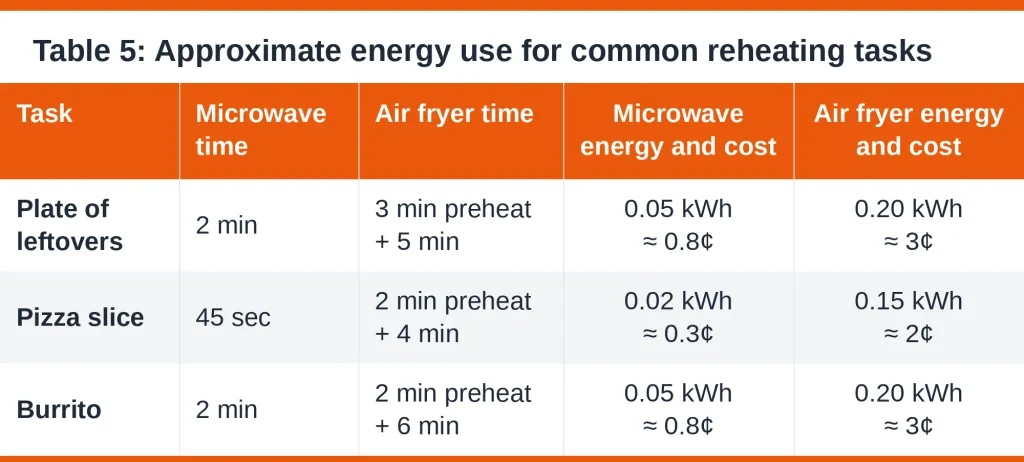
The air fryer uses roughly 4 to 8 times more energy for these small jobs, but the cost difference is only a couple of cents per meal. For small batches, an air fryer still uses much less energy than heating a full-size oven. If saving every possible watt matters to you, keep the microwave for quick reheats and use the air fryer when texture is worth it.
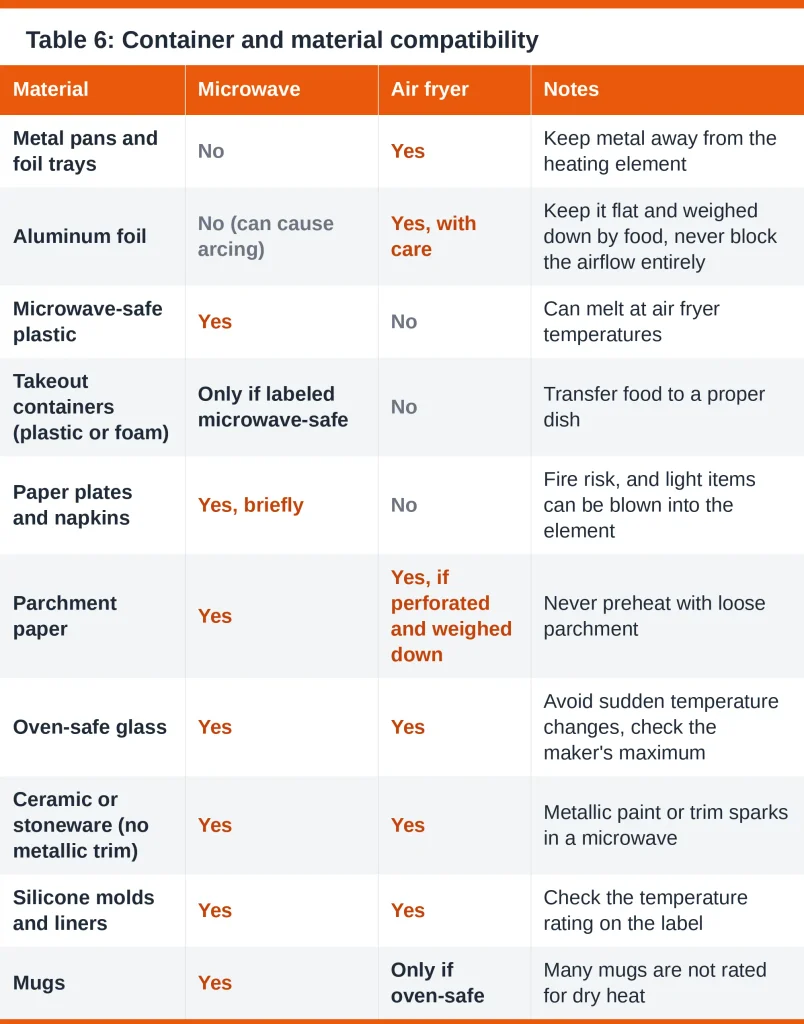
Container and Material Safety: What Can Go Where?
What is safe in a microwave is often unsafe in an air fryer, and the other way round. This is the most common source of accidents when people switch.
Container and material compatibility
Food safety basics
- Reheat leftovers to 165°F (74°C). The USDA lists this as the safe minimum for leftovers and casseroles. See the USDA Safe Minimum Internal Temperature Chart.
- Use a food thermometer. In an air fryer the outside can look done while the middle is still cool. Microwaves have cold spots. A thermometer checks both. The USDA also offers guidance on kitchen thermometers.
- Do not leave oily foods unattended at high temperatures, and keep the air fryer clear of walls and curtains so it can vent.
- Never put liquids in the basket. Hot liquids can spill and the fan can spray them.
- Follow your air fryer’s manual. It is the final word on what your model can handle.
Who Can Replace Their Microwave With an Air Fryer?
You can probably go without a microwave if you:
- Mostly reheat pizza, fries, fried foods, sandwiches and leftovers that should stay crisp
- Cook a lot of frozen snacks, chicken, bacon and vegetables
- Have an electric kettle for hot water, and a stovetop for soups and sauces
- Do not mind waiting a few extra minutes
- Are short on counter space and want one appliance to cover most jobs
You should keep a microwave if you:
- Heat soup, curry, coffee, tea or milk every day
- Rely on microwave rice, steam-in-bag vegetables or instant oatmeal
- Defrost food regularly
- Cook for children who need quick snacks and hot drinks
- Make bagged popcorn, mug meals or melted butter and chocolate
An honest note on space: a 4 to 6 quart air fryer takes up about as much counter space as a compact microwave, so do not buy one just to save room unless it is replacing something.
A practical microwave-free setup
The combination that replaces most microwave jobs is air fryer + electric kettle + stovetop. The kettle covers hot water for coffee, tea, instant noodles and oatmeal. The stovetop handles soups, sauces and rice. The air fryer handles reheating, frozen foods and crisping.
Other options worth knowing about
- Microwave with air fry mode. Several major brands sell combination units that give you both functions in one cabinet. This is the closest thing to a true replacement.
- Air fryer toaster oven. These oven-style models are larger than a basket air fryer, but they can bake, toast, roast and air fry. They are a good choice if you do not want a microwave and you want a bigger cooking space.
- Using a regular oven as a microwave substitute. If you do not own either appliance, an oven can reheat food, just much more slowly. See our guide on how to use an oven as a microwave.
How to Go (Almost) Microwave-Free: A Simple Plan
- Track your microwave use for one week. Write down every time you use it and what for.
- Sort the list. Which tasks are on the Yes list in Table 2, and which are on the No list?
- Cover the No list. Get a kettle, learn two or three stovetop methods, and check whether you really need the defrost function.
- Test the air fryer on your top five reheats. Use Table 3 as your starting point and note the settings that suit your model.
- Keep the microwave for a month before you get rid of it. If you reach for it less than once a week, you probably do not need it.
Tips for Using an Air Fryer as a Microwave Stand-In
- Preheat for 2 to 3 minutes when crispness matters, such as pizza, fries and breaded foods. Skip the preheat for soft foods like wraps and casseroles.
- Go lower and slower for dense foods. Burgers, thick steaks and casseroles reheat more evenly at 300°F to 325°F (150°C to 160°C).
- Do not overcrowd the basket. Air needs to move around the food. Single layer, with gaps, is best.
- Add moisture to dry foods. A light spritz of water on bread or pasta, or a loose foil cover, stops them drying out.
- Shake or flip halfway through the cooking time.
- Use a thermometer to confirm 165°F (74°C) for leftovers.
- Weigh down light foods and liners so the fan does not blow them into the heating element.
- Keep it clean. Grease buildup creates smoke and off flavors. Wipe the basket after each use.
Common Mistakes to Avoid
- Using microwave-only containers. Plastic and paper do not belong in an air fryer.
- Expecting microwave speed. Plan for 5 to 10 minutes, not 60 seconds.
- Reheating rice or pasta uncovered. It dries out and goes hard. Use a covered dish with a little water.
- Putting liquids in the basket. Use a pan, microwave or kettle instead.
- Skipping the thermometer. Surface color is not a safe indicator of temperature.
- Overfilling the basket. It leads to uneven heating and pale food.
- Ignoring the manual. Some manufacturers advise against certain foods, such as loose popcorn kernels.
Frequently Asked Questions
Can I reheat food in an air fryer instead of a microwave?
Yes. An air fryer reheats most solid foods well, and crispy foods much better than a microwave. It takes longer, usually 3 to 5 times as long. Soups, sauces and anything liquid should still go in the microwave or on the stovetop.
Is reheating in an air fryer healthier than using a microwave?
The difference is small. Neither method is meaningfully healthier for reheating. The air fryer gives crisp results without adding oil, while the microwave is faster and keeps food moist. What matters most is the food itself and making sure it reaches 165°F (74°C).
Can an air fryer heat water or soup?
Not safely or practically. The basket is perforated and the fan moves air at high speed, so liquids can spill or splash. Use a microwave, kettle or stovetop.
Can an air fryer defrost food?
Only if your model has a defrost setting, and even then it is slow. For most air fryers it is better to defrost in the refrigerator or cold water, or to cook foods from frozen.
Does an air fryer use more electricity than a microwave?
For small reheating jobs, yes. An air fryer typically uses roughly 4 to 8 times more energy than a microwave for the same task, mostly because of preheating and longer cooking times. The cost is still only a few cents per use.
Can I put microwave-safe containers in an air fryer?
Only if they are also oven-safe. Microwave-safe plastic, paper and many takeout containers can melt or burn at air fryer temperatures. Oven-safe glass, ceramic and metal pans are fine.
Can I make popcorn in an air fryer?
It is not recommended. Loose kernels can fly into the heating element, and many manufacturers’ manuals advise against it. Use a microwave or a stovetop pot.
Can I use an air fryer as a microwave in a dorm or RV?
For most tasks, yes, especially when paired with an electric kettle. You will not be able to defrost quickly or steam vegetables, so check what you rely on the microwave for before you decide.
Is there an appliance that does both?
Yes. Combination microwave ovens with an air fry function are sold by several major brands. They give you microwave speed for liquids and defrosting, plus air fryer crispness for everything else.
Final Verdict: Can an Air Fryer Replace a Microwave?
An air fryer can replace a microwave for reheating crisp foods, cooking frozen snacks, and handling small meals, and it will give better results than a microwave. It cannot match a microwave for speed, liquids, steaming, defrosting or popcorn.
Choose an air fryer only if your cooking is mostly solid, crisp foods, and you have a kettle and stovetop for the rest.
Keep a microwave if you heat drinks, soups or instant meals every day.
Get a combination unit if you want one appliance that does both.
For most households, the best answer is to use both: the microwave for speed and moisture, the air fryer for texture. Use the charts in this article as your starting point, and our oven to air fryer converter whenever you want to translate an oven recipe.
